AeroMorning – John Smith – 6 juillet 2026
Executive Summary
In less than two weeks, one of Europe’s most closely watched defence transactions underwent a dramatic reversal.
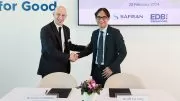
On 26 June 2026, Safran and Exail Technologies announced exclusive negotiations regarding Safran’s proposed acquisition of Exail at €128.50 per share (~€3.5 billion).
On 3 July, both companies announced that negotiations had ended without agreement, citing only their inability to reach “mutually acceptable terms.”
Three days later, on 6 July, Thales announced a binding agreement with the Gorgé family at €134 per share, followed by a mandatory tender offer for the remaining shares, valuing Exail at ~€3.9 billion.
This rapid sequence raised questions: was the higher price decisive, did Exail’s ownership structure matter, or did Thales offer a more compelling industrial future?
This article reconstructs the events from Safran, Exail Technologies and Thales’ official communications, then examines structural, financial and industrial factors that may explain the outcome.
1. Official Timeline
26 June 2026 — Exclusive negotiations
Safran and Exail simultaneously announced exclusive negotiations at €128.50 per share, stressing that:
- discussions were ongoing;
- no binding agreement had been reached;
- completion remained subject to further talks and customary approvals.
3 July 2026 — Negotiations end
Both companies announced termination of talks. Safran offered no details on valuation, governance, financing, shareholder matters or competing offers. Exail reaffirmed its long-term strategy.
6 July 2026 — Thales announces an agreement
Thales announced a binding deal to acquire 35.51% at €134 per share and launch a mandatory tender offer (~€3.9bn equity value), emphasising strategic rationale: autonomous systems, underwater robotics, inertial navigation and sovereign defence technologies. Raphaël Gorgé described the deal as the best long-term solution for Exail.
2. Comparing the Companies’ Communication
Safran: procedural discipline — focused on process, avoided substance.
Exail: neutrality until signature — neutral during talks; public endorsement only after signing.
Thales: an industrial vision — highlighted long-term integration and strategic capabilities (autonomous naval systems, mine countermeasures, underwater robotics, inertial navigation, AI, European sovereignty).
3. Understanding Exail’s Ownership Structure
Beyond the listed company, Exail Holding (private) includes hybrid instruments and contractual liquidity rights that an acquirer must consider.
The diagram referred to in company disclosures is simplified and illustrative.
4. The €380 Million Valuation Gap
The dispute with ICG concerned the cost of unwinding its position in Exail Holding, not Exail Technologies’ intrinsic value.
Exail’s approach
- ~€580m to redeem ICG’s bonds and preference shares;
- ~€130m for minority liquidity rights;
Total: ~€710m (based on contractual features/redemption framework).
ICG’s approach — derive from Exail Technologies’ market value: ~€1.1bn.
Resulting gap: €1.1bn − €710m ≈ €380m — a difference in valuation basis for hybrid instruments/liquidity rights within the holding company.
Why Did Safran’s Bid Fail?
No official reason given. Analysis must separate disclosed facts, public information and reasoned interpretation. Multiple factors likely interacted.
5. Factor One — Price was necessary, but not sufficient
| Safran | Thales | |
| Offer price | €128.50 | €134.00 |
| Difference | — | +€5.50 (+4.3%) |
| Equity valuation | ~€3.5bn | ~€3.9bn |
The premium roughly mirrors the €380m gap within Exail Holding, giving the seller financial flexibility. The < 72h turnaround indicates structural and industrial factors also mattered.
6. Factor Two — More complex than a conventional public takeover
Any buyer had to consider both the listed-company acquisition and implications for the holding’s capital structure (hybrid instruments, liquidity rights).
7. Factor Three — The ICG valuation dispute
Uncertainty of several hundred million euros could not be ignored. Thales explicitly referred to the treatment of Exail Holding instruments.
8. Factor Four — Industrial logic
Exail–Thales appears a stronger industrial fit than Exail–Safran.
| Capability | Safran | Thales |
| Naval combat systems | ★★☆☆☆ | ★★★★★ |
| Underwater warfare | ★☆☆☆☆ | ★★★★★ |
| Autonomous naval systems | ★☆☆☆☆ | ★★★★★ |
| Inertial navigation | ★★★☆☆ | ★★★★★ |
| Aircraft propulsion | ★★★★★ | ★ |
Exail’s focus areas (AUVs, mine countermeasures, fibre-optic gyros, INS, underwater robotics) reinforce Thales’ naval and defence-electronics portfolio.
9. Factor Five — Quality of the industrial proposal
Thales outlined complementarities, synergies, sovereignty and the rising role of autonomy, suggesting a more complete integration plan.
10. Factor Six — The Gorgé family’s perspective
Beyond price: industrial strategy, preservation of capabilities, long-term investment, employee development and European positioning likely weighed in.
11. Exclusivity and the speed of events
Speed reflects prior preparation typical of large defence M&A. No indication of exclusivity breach.
Interim Assessment
Taken together: financial attractiveness, greater certainty on a complex ownership structure, stronger industrial complementarity and a long-term vision aligned with the controlling shareholder.
How Exail Fits Into Thales’ Strategic Future
Exail represents vertical consolidation within Thales’ naval/defence-electronics ecosystem.
12. Exail’s technological core
- autonomous underwater systems (AUVs, mine countermeasures, subsea robotics);
- inertial navigation (fibre-optic gyros, high-performance INS);
- maritime autonomy and mission software (planning, multi-vehicle coordination, fusion/decision);
- photonics and advanced sensors.
13. Structural shift in naval warfare
- expansion of unmanned naval systems (surface, underwater, distributed sensors);
- strategic importance of seabed infrastructure;
- growth of contested/GPS-denied environments.
14. Industrial fit and expected synergies
Thales leads in naval combat systems, sonar/detection, mission systems and defence sensors; Exail fills the autonomous execution layer.
Vertically integrated naval stack
SENSING (sonar, acoustic, mapping) ↓
NAVIGATION (INS, gyros, positioning) ↓
DECISION (AI, mission planning, autonomy) ↓
EXECUTION (AUVs, robotics) ↓
COMMAND INTEGRATION (combat systems, fleet coordination)
Synergy potential
Industrial
- consolidation of overlapping R&D;
- integration of sonar/navigation/autonomy;
- supply-chain optimisation.
Commercial
- cross-selling via Thales’ global naval base;
- expansion into autonomous programmes;
- greater access to NATO/allied frameworks.
Strategic
- stronger European sovereign capabilities;
- reduced reliance on non-European suppliers;
- enhanced competitiveness vs. US primes.
15. European sovereignty dimension
A combined Thales–Exail strengthens Europe’s ability to design, integrate and operate autonomous naval systems within a sovereign framework.
16. Impact on the European defence landscape
- consolidation of underwater defence capabilities;
- increased competition with US primes;
- faster deployment of autonomous naval systems;
- further industry consolidation.
Final Assessment
Between 26 June and 6 July 2026, the outcome appears driven by more than price. Thales combined a higher offer, clearer resolution of holding-structure complexity, stronger industrial fit and a well-articulated integration strategy aligned with the controlling shareholder — amounting to a reconfiguration of capabilities in Europe rather than a simple change of ownership.