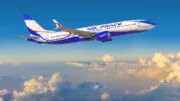
Vietnam Airlines Expands Boeing 737 MAX Fleet: Why the Airline Is Choosing Boeing for Narrowbody Growth While Retaining Airbus for Long-Haul Operations
AeroMorning – July 22, 2026
Vietnam Airlines is strengthening its future narrowbody fleet with 19 additional Boeing 737-8 aircraft through leasing agreements with three major aircraft lessors. The move is not a complete break with Airbus, but rather a strategic fleet transformation aimed at replacing ageing Airbus A321s, securing capacity for future growth and diversifying the airline’s supplier base.
The agreements, announced during the 2026 Farnborough International Airshow on July 22, 2026, cover:
- 10 Boeing 737-8 aircraft from SMBC Aviation Capital;
- 4 aircraft from Avolon;
- 5 aircraft from Phoenix Aviation Capital, managed by AIP Capital.
The leased aircraft will complement Vietnam Airlines’ existing commitment for 50 Boeing 737 MAX 8s, bringing the airline’s planned 737 MAX fleet to 69 aircraft. Deliveries are expected to begin in 2028.
Rather than being a simple fleet expansion, the decision reflects Vietnam Airlines’ long-term strategy to modernize its short- and medium-haul operations while preparing for continued growth in one of Asia’s fastest-growing aviation markets.
A strategic move to modernize the narrowbody fleet
For more than two decades, Vietnam Airlines has relied heavily on the Airbus A321 family for its domestic and regional operations. The aircraft have been the backbone of the carrier’s short-haul network, connecting Vietnam’s major cities and serving regional destinations across Southeast Asia.
However, many of the airline’s earlier-generation Airbus A321ceo aircraft are now approaching the point where replacement becomes economically attractive. The Boeing 737 MAX 8 has been selected as the future cornerstone of Vietnam Airlines’ narrowbody fleet, offering compared with older-generation aircraft:
- lower fuel consumption;
- reduced maintenance and operating costs;
- improved environmental performance;
- greater range flexibility for regional operations.
The transition will allow Vietnam Airlines to gradually retire older A321ceo aircraft while adding capacity to meet growing passenger demand.
Why Boeing instead of Airbus?
The decision should not be interpreted as Vietnam Airlines abandoning Airbus. The airline remains a major Airbus operator, particularly for long-haul flights. Instead, the choice of the Boeing 737 MAX reflects several strategic considerations.
1. Replacing ageing Airbus A321ceo aircraft
Vietnam Airlines’ current narrowbody fleet is dominated by Airbus A321s, including many earlier-generation A321ceo aircraft. These aircraft have served the airline well but are approaching the stage where replacement becomes economically attractive.
The Boeing 737 MAX 8 provides Vietnam Airlines with a modern single-aisle aircraft capable of replacing older A321s while improving operational efficiency.
2. Aircraft availability and delivery timing
One of the key factors behind the decision is the current availability of new aircraft. Airbus continues to face very long delivery lead times for the A320neo family, which influenced the decision. For a rapidly expanding airline, the ability to obtain aircraft within the required timeframe can be as important as the aircraft’s technical performance.
3. A strategic relationship with the United States
The agreement for 50 Boeing 737 MAX 8 aircraft, finalized in February 2026, was supported by U.S. financial institutions, including a proposed US$2.9 billion financing package backed by the U.S. Export-Import Bank (EXIM). The deal strengthens aviation and industrial cooperation between Vietnam and the United States while supporting Vietnam Airlines’ long-term growth ambitions.
4. Reducing dependence on a single manufacturer
Before selecting the 737 MAX, Vietnam Airlines’ narrowbody fleet consisted almost entirely of Airbus A320-family aircraft. Introducing Boeing aircraft gives the airline greater flexibility by avoiding complete dependence on one manufacturer. A mixed fleet can provide advantages in negotiations, financing options and aircraft availability. Many major airlines operate mixed Airbus-Boeing fleets for these reasons.
Airbus remains a key partner
Despite the Boeing 737 MAX decision, Vietnam Airlines is not leaving Airbus. The airline continues to operate a substantial Airbus fleet, particularly for long-haul services.
Its current Airbus widebody fleet includes:
- Airbus A350-900 aircraft, used on major international routes including Europe, Australia and Northeast Asia.
Vietnam Airlines also operates a large number of Airbus A321-family aircraft, including newer A321neo models. The airline’s future long-haul strategy is expected to continue involving both Airbus and Boeing products, with potential future requirements for additional widebody aircraft.
The current fleet strategy can therefore be summarized as:
- Short and medium haul: gradual transition from older Airbus A321ceo aircraft toward Boeing 737 MAX 8 aircraft;
- Long haul: continued operation of Airbus A350 and Boeing 787 fleets.
Vietnam Airlines’ current fleet
Vietnam Airlines currently operates a fleet of 96 aircraft, making it one of Southeast Asia’s largest full-service carriers.
Its fleet includes:
Narrowbody aircraft
- 42 Airbus A321-200
- 20 Airbus A321neo
- 3 Airbus A320neo
The airline has 50 Boeing 737 MAX 8s on firm order, to which the newly announced 19 leased aircraft will be added. Once all deliveries are completed, Vietnam Airlines expects to operate 69 Boeing 737 MAX 8s, making the type the cornerstone of its domestic and regional operations.
These aircraft operate Vietnam’s dense domestic network and regional routes throughout Asia.
Widebody aircraft
- 14 Airbus A350-900
- 11 Boeing 787-9 Dreamliner
- 6 Boeing 787-10 Dreamliner
The widebody fleet supports long-haul services to Europe, Australia, Japan, South Korea and other international markets.
Once the Boeing 737 MAX program is fully delivered, Vietnam Airlines will operate a more diversified fleet, with the 737 MAX becoming the foundation of its future narrowbody operations.
Supporting Vietnam’s aviation growth
Vietnam is one of the fastest-growing aviation markets in Asia. The country benefits from:
- strong economic development;
- rising middle-class demand;
- rapid tourism growth;
- expanding international investment;
- major airport infrastructure projects.
New airports, including the development of Long Thanh International Airport near Ho Chi Minh City, are expected to create additional opportunities for Vietnamese airlines. Vietnam Airlines is therefore preparing for a significant increase in passenger traffic over the next decade.
A new phase for Vietnam Airlines
The decision to add 19 leased Boeing 737 MAX 8 aircraft marks an important turning point for Vietnam Airlines. The airline is not replacing Airbus with Boeing; instead, it is reshaping its fleet according to operational needs.
The future strategy is clear:
- use Boeing 737 MAX aircraft as the new-generation narrowbody platform;
- maintain a mixed Airbus A350 and Boeing 787 long-haul fleet for premium long-haul operations;
- continue operating Boeing 787 Dreamliners;
- build a flexible fleet capable of supporting Vietnam’s aviation growth.
The airline has not announced any plans to retire its Airbus A350 fleet, which remains central to its intercontinental network. The move reflects a broader trend among major airlines: selecting aircraft based on availability, economics, financing and strategic flexibility rather than loyalty to a single manufacturer. Vietnam Airlines’ future fleet will therefore likely remain a balanced combination of Airbus and Boeing aircraft.