




HAdrien Canter is the CEO of Alta Ares, a French company that was born in Ukraine two years ago. From encounters with combat units on the Eastern front emerged the idea of developing precise, AI-powered interceptor drones. AeroMorning met with the team of this startup, which has earned its stripes following its baptism by fire.
“Two years ago, we observed cognitive fatigue among Ukrainian soldiers dealing with anti-drone efforts, especially against Shahed drones,” explains the thirty-something CEO, who leads a team of 32 employees. This deep understanding of needs, drawn directly from the front lines, convinced him of the necessity to integrate AI into drones to automate many of the daily tasks seen in Ukraine. “AI allows us to automate detection, identification, and intelligence tasks using incredible computing power.” Since then, several Ukrainian brigades and the French army have taken interest due to the positive results. Today, Alta Ares operates globally, with offices in Paris, New York, Athens, and Kyiv—drawing on real-world war experience for its expertise.
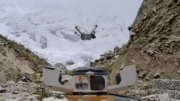
Alta Ares developed an AI-powered software called Pixel-Loc, capable of automatically intercepting targets like loitering Shahed munitions. Observing that human-piloted interceptions succeed only 30% of the time, a more effective technical solution was needed. Their system involves a ground radar that detects the target, sends its coordinates to the interceptor drone, and controls the motors to direct it toward interception. This operation involves a team of a remote pilot, a navigator, and a data transmitter. The entire setup is controlled through a portable system with two monitors. According to the company, the software has doubled the success rate to around 60%. “This is just the beginning. A Patriot missile achieves about 80%… but it costs $1.5 million!” says Adrien.
“On the Eastern Front, Quantity Becomes Quality”
This system is now recognized by drone specialists and military forces. The turning point came when Alta Ares won the NATO award in Poland at the JATEC center—a NATO-Ukraine joint organization activated by order of the North Atlantic Council on December 16, 2024. Yet for the entrepreneur, it’s not about accolades—it’s about the mission. That sense of mission is also what motivates and attracts talent to the company, he claims. “On the Eastern Front, quantity becomes quality,” he explains. Since the beginning of the war, high-tech has given way to low-tech. On the front lines, it’s now clear that swarms of cheap drones—sometimes even commercially bought—can overwhelm air defense systems. New models and new ways of thinking are needed.
In Ukraine, more and more companies are developing AI-powered software similar to Alta Ares’s. It’s estimated that 28 Ukrainian companies have turned their war efforts toward this technology as of writing. Most of them are being used for autonomous interception applications. Despite this, Alta Ares’s system still leaves the final decision to a human, who can view the locked target on a screen before action. “Every successful strike is recorded by onboard cameras to help better train our defense AI.”
On the market side, it’s estimated that Ukraine will need 20,000 interceptor drones. Alta Ares aims to scale up accordingly, targeting €20 million in revenue and production of 1,000 drones per month by 2026. So far, Alta Ares has raised €2.5 million in just six months. Out of necessity, they developed their own interceptor drone, the X-Lock, in partnership with Ukrainian company Bagnet. It is manufactured in both Ukraine and France. Also in development: the Blackbird, which will be capable of flying at over 670 km/h.
In the face of this new asymmetric warfare, Ukraine has, since February 2022, become an open-air tech laboratory—paid for in blood.
Jean-François Bourgain, December 17, 2025, for AeroMorning


Be the first to comment on "French Company Alta Ares Learns from the Ukrainian Front"