





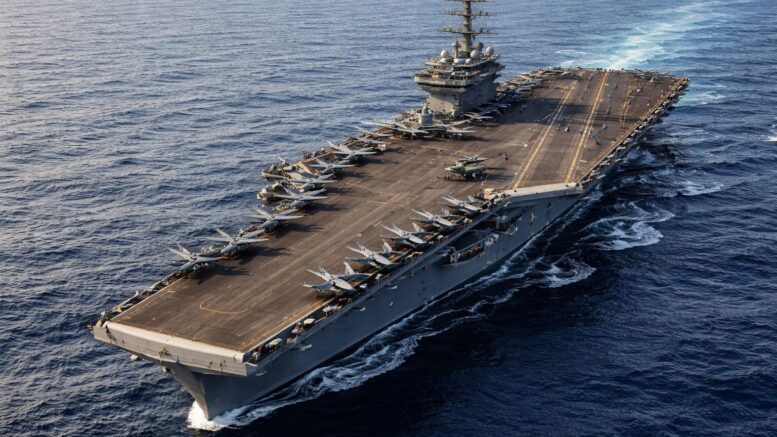
France is preparing to build a new aircraft carrier—a colossal project worth over 10 billion euros—aimed at replacing the venerable Charles de Gaulle, in service since 2001. This decision, officially announced by Emmanuel Macron on December 21, 2025, in the United Arab Emirates, underscores the strategic importance of this vessel for national defense and sovereignty, especially in a tight budgetary context.
The announcement, made by President Emmanuel Macron, regarding the start of construction of a new aircraft carrier, came as no surprise. It was made in Abu Dhabi during a visit to pre-positioned forces in the UAE. “We must be strong at sea. (…) I have decided to equip France with a new aircraft carrier,” he explained. Although the decision was described as “taken this week,” it is in fact the result of years of consideration within military and engineering circles, and has featured in the last two military programming laws. As early as April 2024, the DGA (French defense procurement agency) had placed an order worth approximately €600 million to begin initial work and secure the supply chain. This was a crucial step to stay on schedule for completion by 2038. Another indication came in September 2025, when the DGA also approved the start of construction of the first nuclear boiler rooms—evidence that the plan was already transitioning from intention to execution.
The Charles de Gaulle, flagship of the French Navy, is nearing the end of its service life. Aircraft carriers typically have a lifespan of about 40 years, and the Charles de Gaulle, launched in 1994, will soon be obsolete. Without a replacement, France would be left without an aircraft carrier by around 2030.
What is the Charles de Gaulle used for today?
The Charles de Gaulle is the flagship of the French Navy and France’s main tool for projecting naval air power far from its own territory. It allows operations without relying on land bases. It carries an embarked air group, including Rafale Marine fighter jets, E-2C Hawkeye airborne early warning aircraft, and helicopters. Its mission capabilities include air defense, deep strike, reconnaissance, intelligence, and support for operations. Its nuclear propulsion gives it great autonomy, enabling extended deployments at sea, which also makes it a tool of conventional deterrence, crisis management, and diplomacy. It protects and leads a full naval task force within a carrier strike group.
The Future Aircraft Carrier: A Giant of the Seas
Shipyards in Saint-Nazaire are already hard at work designing this new behemoth. Contracts are being signed, and details of the new vessel are already known. It will weigh around 80,000 tons—nearly twice the weight of the Charles de Gaulle (42,000 tons)—and measure 310 meters long. The PANG (arresting wire) will be significantly larger, with a broader flight deck capable of carrying about thirty combat aircraft, including the Rafale and potentially the future European fighter jet, as well as 2,000 sailors. It will also be able to host a fleet of drones.
Numerous technological innovations are planned. The catapults used to launch aircraft will be upgraded to electromagnetic technology, allowing two aircraft to be launched every 30 seconds, compared to just one currently. Artificial intelligence will be integrated on board, along with enhanced communication systems for coordination with the carrier strike group. Its detection capabilities will be vastly improved to counter new threats such as hypersonic missiles and sea/air drones. Its nuclear propulsion will also be optimized for better endurance at sea.
Why Such an Investment?
France is determined to maintain an aircraft carrier because it’s a powerful tool for striking or monitoring anywhere in the world. The government is fully backing this program, with a budget estimated between 10.2 and 10.25 billion euros. It is also a key element of France’s nuclear deterrent, as some of the embarked aircraft can carry nuclear missiles—making the carrier a symbol of national sovereignty and independence in the face of international threats.
An aircraft carrier is not “just another ship” but a system of systems, combining embarked aviation, command, logistics, protection, and extended reach. The goal is also to maximize the use of French- or European-made components, supporting the national economy and its 800 suppliers, the majority of which are SMEs. The program involves not just an army of subcontractors, but also key players such as Naval Group, Chantiers de l’Atlantique, and TechnicAtome.
Even with political approval, the program faces several risks. Despite recent progress, uncertainties remain. The new-generation electromagnetic catapult, for instance, will be provided by an American company. This raises concerns about the U.S. potentially using this strategic contract to exert pressure on France in other geopolitical matters. Another issue—more symbolic—is the name of the future aircraft carrier. Several names are already being discussed, but the final decision will lie with the President, the Chief of the Defense Staff, and the Ministry of Defense. The Ministry has stated that it is seeking a name that is neither divisive nor controversial.
Jean-François Bourgain, for AeroMorning, 12/27/2025




Be the first to comment on "France Goes All-In on Its New Aircraft Carrier"