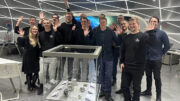
Astrolight: Lithuania’s Emerging Player in Optical Space and Defense Communications
Founded in Vilnius in 2019 by researchers from the Center
for Physical Sciences and Technology (FTMC) and Vilnius Tech, Astrolight is a
Lithuanian space and defense company developing laser-based optical
communications for space, defense, maritime and ground applications. Its
founders include CEO Laurynas Mačiulis, CTO Dalius Petrulionis, Senior Engineer
Julijanas Želudevičius and Production Manager Martynas Milaševičius.
Rather than positioning itself solely as a component manufacturer,
Astrolight aims to build an end-to-end optical connectivity infrastructure—an
“optical backhaul for space”—linking satellites, ground stations and
ships.
Strategic ecosystem and geography
Astrolight benefits from Lithuania’s established expertise
in lasers and photonics, combined with growing space and defense ecosystems.
Its technology has also attracted attention from NATO’s Defense Innovation
Accelerator for the North Atlantic (DIANA) program.
The company has established a Danish subsidiary to
strengthen its position in the Nordic and Arctic markets, including its optical
ground-station project in Greenland.
Financial and employee profile
Astrolight remains a small and growing company, with 40
employees as of October 2026 .
Its reported sales increased from €584,000 in 2024 to
€866,817 in 2025, equivalent to roughly US$1 million. The company recorded a
€339,000 net loss in 2025, while equity increased to €1.99 million and total
assets to €3.35 million. A 2026 revenue is not publicly disclosed .
In May 2025, Astrolight raised €2.8 million in seed funding,
led by Balnord, with participation from EIFO, Coinvest Capital, 3NGLS and Rita
Sakus. The company has also benefited from European Union programs such as
CASSINI and from NATO support.
Technology and products
Optical communications
Astrolight replaces conventional radio-frequency (RF)
communications with highly directional laser beams. Optical links can provide
very high bandwidth, narrow beams, a low probability of interception, greater
resistance to conventional radio-frequency jamming, a low electromagnetic
signature and no dependence on scarce RF spectrum.
One of the main limitations for laser communication systems
is atmospheric conditions: clouds, fog, and other weather phenomena can disrupt
space-to-ground optical links. Astrolight therefore combines terminal
technology with a distributed ground infrastructure strategy: if one optical
ground station is unavailable due to weather conditions, data could potentially
be routed through another station in a different geographical location.
ATLAS: space communications
The ATLAS family is the company’s core space
technology.
ATLAS-1 became the first Lithuanian laser
communications system to reach orbit, launching aboard SpaceX’s Transporter-16
mission in March 2026. The company is also involved in European Commission and
CASSINI-supported in-orbit demonstrations.
ATLAS-2 is a low Size, Weight and Power (Low-SWaP)
terminal designed for both space-to-ground and space-to-space communications.
It weighs 2.3 kg, offers up to 2.5 Gbps for body-steered and gimbaled
space-to-ground and inter-satellite links, with some configurations capable of
reaching up to 100 Gbps. It consumes approximately 1 W in idle mode and 30 W
while transmitting, and provides fine-pointing accuracy below 15 microradians.
It also incorporates in-orbit self-calibration. It is SDA-compatible.
ATLAS-X-MINI adds a gimbal, allowing hemispherical
pointing. It features a 40 mm aperture, up to 2.5 Gbps downlink for
body-steered and gimbaled space-to-ground and inter-satellite links, with some
configurations capable of reaching up to 100 Gbps, and 156 Mbps uplink, and is
compatible with Space Development Agency (SDA) Optical Communications Terminal
(OCT) 3.1 requirements.
Ground segment
Astrolight’s OGS-2.5 Optical Ground Station supports
SDA and Consultative Committee for Space Data Systems (CCSDS) standards, with
14- or 20-inch apertures. Published capabilities include downlink rates of up
to 12.5 Gbps and uplink rates of up to 2.5 Gbps.
The company is also developing an optical ground station in
Kangerlussuaq, Greenland, through the European Space Agency’s (ESA) ScyLight
program. The station is intended to benefit from the visibility of
polar-orbiting satellites and favorable Arctic conditions for optical
communications.
POLARIS: defense and maritime communications
POLARIS is a free-space optical communications terminal
designed for naval platforms and unmanned surface vessels. It offers up to 1
Gbps, 4 W optical power, and approximately 200 W electrical consumption, with a
mass of around 16 kg.
The system has been tested by the Lithuanian Navy in the
Baltic Sea and during NATO’s REPMUS/Dynamic Messenger exercise in Portugal,
where Astrolight demonstrated a radio-silent link exceeding 15 km. POLARIS was
also tested during NATO’s DiBaX exercise in Latvia. Astrolight has signed a
memorandum of understanding (MoU) with Naval Group concerning potential naval
applications.
Business model and strategy
Astrolight’s strategy has two layers: selling hardware such
as ATLAS, ATLAS-X, Optical Ground Stations and POLARIS and ultimately offering connectivity
as a service through space-to-ground, space-to-ship, ship-to-ship,
ground-to-ground,and inter-satellite optical links.
Competition and European positioning
Astrolight operates in an increasingly competitive market
that includes TESAT, Rocket Lab/Mynaric, CACI, Skyloom, Kepler Communications,
Thales Alenia Space, SpaceX, Cailabs and Archangel Lightworks.
Its differentiation lies in its combination of low-SWaP
technology, products designed for manufacturing at scale, vertical integration,
European industrial positioning, interoperability, and dual-use applications
across space and defense. Its relationships with ESA, the European Commission,
NATO DIANA, and other European organizations provide additional institutional
validation.
Its main challenges are equally clear: atmospheric
limitations and scaling manufacturing to potentially thousands of
terminals,.
The company’s systems are built with off-the-shelf
components and designed for high-volume manufacturing, which helps reduce costs
and lets the company compete in the small-satellite market, where larger
players’ solutions are often not viable.
Astrolight at a glance — October 2026
- Origin
/ HQ: Lithuania / Vilnius
- Founded:
2019
- Leadership:
Laurynas Mačiulis (CEO), Dalius Petrulionis (CTO)
- Employees:
40
- 2025
revenue: €866,817 (~US$1m), excluding grant funding
- 2026
revenue: not publicly disclosed
- Funding:
€2.8m seed round, May 2025
- Core
technology: Free-space optical and laser communications
- Space:
ATLAS-2 / ATLAS-X / ATLAS-X MINI
- Ground:
OGS-2.5
- Defense
/ maritime: POLARIS
- Key
relationships: Clients and partners across commercial and defense
sectors
- Strategic
ambition: End-to-end optical connectivity systems forming an “optical
backhaul for space.”