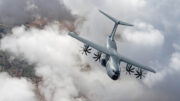
French Air Force Deploys A400M Atlas in Real-World Firefighting Mission: A New Heavyweight Capability Against Wildfires
AeroMorning — July 27, 2026
The French Air and Space Force has demonstrated for the first time the operational potential of the Airbus A400M Atlas as a large-scale aerial firefighting platform, using a dedicated kit capable of releasing 20,000 litres of retardant in a single pass.
Initially designed as a military tactical transport aircraft, the A400M has now shown its ability to support wildfire containment operations, adding a new capability to France’s existing aerial firefighting fleet.
This operational deployment follows several years of development and testing by Airbus Defence and Space in cooperation with firefighting authorities and European partners.
A400M Atlas: From Military Transport Aircraft to Firefighting Platform
The A400M firefighting capability relies on a removable Roll‑on/Roll‑off (Ro‑Ro) kit, allowing rapid conversion from transport to aerial firefighting without structural modification.
The system consists of:
- an internal tank installed inside the cargo hold;
- discharge pipes connected to the ramp area;
- a gravity-based release system for rapid dispersal of water or retardant.
The conversion requires no permanent modification. Airbus indicates the kit can be installed rapidly on operational aircraft.
A 20,000‑Litre Fire Retardant Capability
The A400M configuration is designed to carry and release 20 tonnes of water or retardant. This represents:
- approximately 20,000 litres of firefighting liquid;
- a capacity equivalent to around two Dash aircraft loads;
- more than three Canadair CL‑415 drops in volume.
During Airbus test campaigns, the aircraft released up to 20 tonnes of water in less than 10 seconds, validating low‑altitude, low‑speed drops with controlled dispersal.
Low‑Altitude Precision Drop Capability
Validated drops were performed from approximately 45 metres (150 feet) above ground level during initial trials, and at even lower altitudes, below 30 metres (100 feet), at around 230 km/h (125 knots) during recent evaluations.
This low‑altitude capability is essential, as effectiveness depends on accuracy, concentration and placement of the retardant line as much as on volume.
A High‑Concentration Retardant Line up to 400 Metres
The A400M is intended to complement specialised water bombers by creating large defensive retardant lines ahead of advancing flames. Tests demonstrated lines up to 400 metres.
Unlike water drops that mainly cool burning vegetation, retardant forms a chemical barrier that remains effective after evaporation.
Comparison with Existing Firefighting Aircraft
Canadair CL‑415 / DHC‑515
- approximately 6,000 litres per drop;
- ability to refill directly from lakes or coastal areas;
- very rapid turnaround when water sources are nearby.
Dash Aircraft
- approximately 10,000 litres per drop;
- higher cruising speed;
- longer range than amphibious aircraft.
The A400M provides roughly twice the payload of a Dash in a single pass.
A400M Atlas
| Capability | A400M |
|---|---|
| Payload | 20,000 litres |
| Product | Water or retardant |
| Drop altitude | Around 30–45 metres during tests |
| Drop duration | Less than 10 seconds |
| Retardant line | Up to 400 metres |
| Deployment | Rapid conversion using removable kit |
| Main role | Strategic fire containment |
Operational Effectiveness: Where the A400M Adds Value
- Rapid creation of defensive fire lines with 20 tonnes delivered in one pass.
- Protection of populated areas, strategic infrastructure, evacuation routes and vulnerable forests.
- Access to remote areas thanks to tactical performance from shorter, less prepared runways.
The A400M is a complementary tool to Canadair and Dash fleets. Future response will likely combine Canadair/DHC amphibians for rapid repeated water attacks, Dash for medium-scale tanker operations, and A400M for large retardant barriers and strategic containment.
Source: AeroMorning