Sri Lanka and EHang’s Global Fast Track Programme: a potential new pathway for pilotless eVTOL operations
AeroMorning – John Smith – August 19, 2026
On 19 August 2026 in Colombo, EHang announced that Sri Lanka had become the first country to adopt its Global Fast Track programme, a structured pathway designed to potentially compress the time from initial regulatory engagement to commercial deployment of pilotless eVTOLs from years into months.
What is a regulatory sandbox?
In aviation, a regulatory sandbox is a controlled testing environment established with an aviation authority to evaluate technical, operational and safety requirements under defined conditions (operating areas, approved routes, ground infrastructure, remote control, personnel, emergency procedures) without opening the operation to unrestricted commercial service.
Adopted by Sri Lanka’s Ministry of Ports and Civil Aviation and the Civil Aviation Authority of Sri Lanka (CAASL), the initiative targets initial sandbox commercialisation within four months, strictly conditional on completing all required regulatory, technical, operational and safety assessments and approvals.
The four stages of Global Fast Track
- Regulatory framework alignment
- Sandbox build-out
- Validation flights
- Commercial launch
The initial sandbox will focus on Port City Colombo. Potential applications include:
- Sightseeing flights around Sigiriya and Pidurangala
- Shuttles between Katunayake Airport and central Colombo hotels
- Tourist mobility within Port City and Greater Colombo
- Unmanned maritime cargo logistics
EHang will provide aircraft, operating systems, technical services and personnel training.
CAASL’s certification stance
Sri Lanka is not accepting China’s Type Certificate as automatically valid. CAASL is using China’s certification record, testing experience and operational data as the starting point for its own assessment and local approvals. Prior to the announcement, CAASL had begun examining requirements for eVTOL operations. A 30 July technical meeting between CAASL and EHang addressed the regulatory and operational pathways required to safely integrate eVTOL operations into Sri Lanka’s aviation system.
EHang’s international experience
- Thailand: Advanced Air Mobility sandbox with the Civil Aviation Authority of Thailand for EH216-S operations, aiming for commercial operating approval.
- Qatar: Human-carrying trial flights in Doha in November 2025 (Doha Port – Katara Cultural Village), under Qatar Civil Aviation Authority operational authorization and with Ministry of Transport support.
- Switzerland: First pilotless EH216-S flights in July 2026 with the Swiss FOCA, the Municipality of Quinto and DroneVia.
EHang reports over 90,000 safe flights across 22 countries as of end-July 2026.
China: EH216-S certification chain
- Type Certificate: issued 13 October 2023 by CAAC (CCAR-21) with aircraft-specific Special Conditions SC-21-002 (9 February 2022).
- Standard Airworthiness Certificate (per aircraft): issued December 2023.
- Production Certificate: issued April 2024 (series production authorised).
- Air Operator Certificates: issued 28 March 2025 to Guangdong EHang General Aviation Co., Ltd. (wholly owned) and Hefei HeYi Aviation Co., Ltd. (JV) for pilotless human-carrying operations.
EHang cites a >1,000-day certification programme, >500 specific tests, >40,000 test flights, and conformity validation over 65 major categories and >450 individual tests.
As of 31 December 2025, EHang had delivered 593 EH216-S (total eVTOL deliveries including EH216-F, EH216-L and VT35: 628). These aircraft were mainly used for testing, training, demonstrations and trial operations. Delivered aircraft do not equal regular scheduled passenger services. Chinese AOCs do not grant operating rights in Sri Lanka; CAASL must issue local approvals. EHang reported 3,000+ safe missions by its two Chinese AOC holders since March 2025, with zero accidents and zero violations.
EH216-S: specifications and operational use
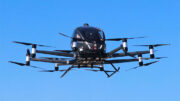
The EH216-S is an integrated unmanned aircraft system (aircraft, ground control station, data link) designed for autonomous flight along pre-programmed routes under remote supervision.
- Configuration/payload: two seats, coaxial multirotor, 8 arms and 16 lift propellers, all-electric propulsion, redundant flight-control and power, fail-safe functions.
- Mass/dimensions: MTOW 620 kg; height 1.93 m; width 5.73 m.
- Speed/range: max design speed 130 km/h; design distance 30 km.
- Endurance/reserves: 25 minutes demonstrated with 25% battery remaining (not full depletion). Actual missions depend on reserves, weight, weather, wind, route and operating conditions.
VT35: a different eVTOL in the pipeline
The VT35 (unveiled October 2025) is a fully electric, non-hybrid, lift-and-cruise, two-seat pilotless eVTOL with eight distributed lift propellers, fixed wings, a rear pusher propeller, ~200 km full-load range, ~950 kg MTOW, dimensions ~8.26 m (L), 8.16 m (span), 3.09 m (H), and an economical cruise speed ≥216 km/h. As of June 2026, CAAC certification was in the Certification Basis definition phase. EHang has not announced a four-passenger model or a piloted-to-pilotless conversion.
Global regulatory approaches
- CAAC (China): aircraft-specific Special Conditions SC-21-002 for EH216-S.
- EASA (Europe): Special Condition VTOL (SC-VTOL) and detailed Means of Compliance.
- FAA (United States): 14 CFR Part 21 framework; §21.17(b) for novel types; AC 21.17-4 (Powered-lift) issued 18 July 2025.
While the philosophies are broadly similar, the rules are not equivalent or automatically interchangeable: a CAAC Type Certificate does not become an FAA or EASA Type Certificate.
Two models for international eVTOL expansion
- Model 1 – Foreign Type Certificate validation (EHang / Sri Lanka): the host regulator (CAASL) uses the foreign certification record as the starting point and conducts its own assessments, validation flights and local approvals.
- Model 2 – Local Restricted Type Certification (Archer / UAE): a national restricted certification path enabling limited commercial operations without relying on the State-of-Design Type Certificate.
Why Sri Lanka matters
Beyond operating EHang aircraft in another country, the key question is whether a pilotless eVTOL that has completed full aircraft certification in one jurisdiction can be efficiently assessed and approved by another national authority using the existing evidence base. Global Fast Track proposes moving from regulatory alignment to sandbox development, validation flights and ultimately commercial operations. The four-month target is ambitious and remains conditional on completing all required assessments and approvals. Sri Lanka will test whether China’s certification and operating experience can translate across borders and whether EHang’s pilotless model can evolve into an international operating framework, potentially paving the way for larger, longer-range aircraft like the VT35.