




Artemis II: Deep-Space Human Flight, Radiation Exposure, and Implications for Long-Duration Exploration
AeroMorning March 29, 2026
1. Mission Architecture and Timeline
Artemis II is the first crewed mission of NASA’s Artemis program, marking a transition from Low Earth Orbit (LEO) operations to sustained human presence in cislunar space.
- Launch: April 1, 2026
- Landing: April 10, 2026
- Duration: ~10 days
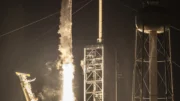
The mission will be launched aboard the Space Launch System Block 1 high lift rocket, with crew transported in the Orion Multi-Purpose Crew Vehicle. Mission phases include:
- High Earth orbit insertion (~24-hour period) for spacecraft system validation
- Translunar injection (TLI) burn (~3.2 km/s delta-v)
- Free-return lunar flyby with pericynthion ~7,000–10,000 km
- Passive Earth return via gravitational dynamics with skip reentry (~11 km/s)
This architecture emphasizes mission robustness through a free-return trajectory that provides inherent contingency in the event of system failure.
2. Crew and Operational Roles
The Artemis II crew comprises:
- Reid Wiseman – Commander
- Victor Glover – Pilot
- Christina Koch – Mission Specialist
- Jeremy Hansen – Mission Specialist
Crew responsibilities include deep-space navigation, life support monitoring, manual spacecraft operations, and contingency management. This mission will be the first human-rated test of Orion Multi-Purpose Crew Vehicle in deep space, providing critical operational data for Artemis III and beyond.
3. Trajectory and Cislunar Environment
Artemis II will follow a free-return trajectory around the Moon, meaning the spacecraft’s path is designed to automatically bring it back to Earth if the propulsion system fails. This trajectory is calculated using the restricted three-body problem, a mathematical model describing the motion of a small object (the spacecraft) under the gravitational influence of two much larger bodies (Earth and Moon). Key parameters:
- Maximum distance from Earth: ~400,000 km
- Lunar flyby altitude: ~7,000–10,000 km
- The largest propulsion effort of the mission is used to leave Earth orbit and head toward the Moon.
Being outside Earth’s magnetosphere exposes the spacecraft and crew to the full spectrum of deep-space radiation, including Galactic Cosmic Rays (GCRs) and Solar Energetic Particles (SEPs).
4. Deep-Space Radiation Environment
4.1 Sources and Characteristics
- Galactic Cosmic Rays (GCRs): high-energy protons and HZE nuclei, energies up to several GeV/nucleon
- Solar Energetic Particles (SEPs): protons accelerated by solar flares or coronal mass ejections (CMEs)
- Secondary Radiation: neutrons and gamma rays produced by interactions with spacecraft shielding
Radiation metrics include:
- Absorbed dose (D, unit Gy): energy deposited per mass
- Dose equivalent (H, unit Sv): absorbed dose weighted by quality factor (Q = accounts for how damaging the type of radiation is to living tissue)
- Linear Energy Transfer (LET, unit keV/µm): energy deposited per unit path length, critical for estimating DNA damage to crew (High LET → more DNA damage → higher biological effect)
4.2 Mission Timing and Solar Activity
The mission coincides with solar maximum (~2025–2026), increasing the likelihood of intense SEPs. Acute exposures from large solar events could deliver doses exceeding recommended astronaut limits in hours, highlighting the importance of real-time monitoring and mitigation.
5. Radiation Measurement and Mitigation
5.1 In-Situ Characterization
Artemis II will conduct direct in-situ measurements of radiation using:
- Active dosimeters: real-time flux and energy spectra
- Passive detectors: thermoluminescent dosimeters (TLDs) and CR-39 nuclear track detectors
- Organ-on-chip systems: cellular-level response to ionizing radiation
This data will validate radiation transport models, refine LET spectra predictions, and inform biological risk assessments.
5.2 Shielding Strategies
- Passive shielding: aluminum structure (~7–10 g/cm²) and hydrogen-rich materials (water, polymers)
- Storm shelter: dedicated compartment with maximal shielding using onboard consumables
- Operational procedures: real-time space weather alerts enabling crew to enter protective zones
5.3 Scientific Objectives
- Validate computational models for dose prediction
- Quantify shielding effectiveness and risk reduction
- Correlate radiation spikes with solar activity for predictive space weather models
- Provide biological data for risk modeling in long-duration missions
6. Additional Operational Risks
- Distance from Earth: limits immediate rescue capability
- Thermal reentry: Although skip reentry moderates heating and deceleration, the capsule will still experience extreme thermal and dynamic loads due to lunar-return velocity (~11 km/s).”
- Communication latency: up to several seconds, requiring increased crew autonomy
- Human factors: confinement, altered circadian rhythms, and cognitive load in deep-space environment
7. Implications for Long-Duration Missions
Artemis II will provide foundational data for missions of weeks to years beyond Earth’s magnetosphere, including lunar surface operations and Mars missions:
- Radiation management: informs shielding and pharmacological countermeasures
- Life support reliability: tests ECLSS systems under extended deep-space conditions
- Crew autonomy: operational procedures for missions with communication delays (up to 20 minutes for Mars)
- Model validation: in-situ data for accurate prediction of long-term exposure effects
8. Conclusion
Artemis II is a critical bridge between LEO operations and interplanetary missions, providing empirical validation of spacecraft systems, radiation exposure, and human physiology in deep space. By integrating operational testing, in-situ radiation measurement, and biological monitoring, Artemis II lays the groundwork for sustainable human exploration of the Moon, Mars, and beyond.


Be the first to comment on "Artemis II: Deep-Space Human Flight, Radiation Exposure"