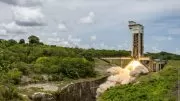
Ariane 6 launches 36 satellites for Amazon’s Project Kuiper
AeroMorning – John Smith – June 17, 2026
Europe’s Ariane 6 rocket successfully launched 36 satellites for Amazon’s Project Kuiper constellation on Wednesday 17 June 2026, marking the first flight of the launcher equipped with upgraded P160C-based solid rocket boosters and establishing a new payload record for a European launch vehicle.
The mission, designated VA269, lifted off from the Guiana Space Centre in Kourou, French Guiana, at 09:21 local time (13:21 BST, 14:21 CEST). The satellites were deployed into their intended low-Earth orbit slightly more than one hour after launch.
The flight was the eighth consecutive successful mission for Ariane 6 since entering service and represents another step in the gradual expansion of Europe’s heavy-lift launch capabilities.
First Flight of the P160C Booster
The most notable feature of the mission was the debut of four upgraded boosters derived from the new P160C solid rocket motor.
Each booster carries approximately 14 tonnes more propellant than the P120C motors previously used on Ariane 6. According to the European Space Agency (ESA), this upgrade increases launcher performance by roughly 10% to 15%, depending on mission profile and target orbit.
The additional capability enabled Ariane 6 to deploy 36 Project Kuiper satellites in a single mission, compared with 32 satellites on earlier launches for the same constellation.
The P160C motor contains around 156 tonnes of solid propellant and stands approximately 14.5 metres tall. Despite being larger than its predecessor, it remains compatible with Ariane 6’s existing architecture and ground infrastructure.
Shared Technology with Vega-C
Europe’s solid rocket booster technology is also closely linked to the Vega-C launch vehicle, a smaller orbital rocket developed to carry light payloads to low Earth orbit.
Vega-C is designed primarily for institutional missions, Earth observation satellites and scientific payloads, with a typical capacity of around 2.3 tonnes to Low Earth Orbit (LEO). It complements Ariane 6 by handling smaller missions that do not require a heavy-lift launcher.
Both Ariane 6 and Vega-C use related solid propulsion technologies, including the P120C motor architecture on earlier configurations. This common industrial base allows Europe to streamline production, reduce costs and maintain flexibility across its launch portfolio.
New European Launch Record
The mission also marked one of the heaviest single launch masses ever delivered by a European launcher, with an estimated total payload of around 19–20 tonnes to low Earth orbit.
The previous high-end reference was set in 2013 by Ariane 5, which launched the ~20.2-tonne ATV (Automated Transfer Vehicle) Albert Einstein cargo spacecraft to the International Space Station (ISS). However, the two missions reflect very different orbital and operational profiles: ATV was a single, tightly controlled spacecraft destined for rendezvous with the ISS, while VA269 deployed 36 separate satellites into a commercial low Earth orbit constellation, requiring multiple sequential deployments and orbital separation maneuvers.
As a result, these figures should be interpreted as indicative benchmarks rather than directly comparable records. They nonetheless highlight the steady increase in European launch capability as Ariane 6 transitions into regular operational service.
A Modular Launcher Designed for Growth
Ariane 6 was designed with a modular architecture intended to support a wide range of missions.
The launcher is available in multiple configurations, including variants with two or four solid rocket boosters. The introduction of the P160C represents the latest evolution of this design approach, increasing payload capacity without requiring major changes to the core system.
European space officials have indicated that additional upgrades remain under evaluation as Ariane 6 enters broader commercial use.
A European Industrial Effort
The P160C booster was developed by Europropulsion under contracts from ArianeGroup and Avio, the industrial partners responsible for Ariane 6 and Vega launcher systems.
Production is distributed across several European countries. The booster structure is manufactured in Italy, the nozzle is produced in France, and the ignition system is supplied by Norway. Final assembly and propellant loading take place at the Guiana Space Centre in French Guiana.
More broadly, Ariane 6 is the result of cooperation between ESA and an industrial network spanning 13 European countries. ArianeGroup acts as prime contractor and design authority, while the French space agency CNES manages launch operations at the spaceport. Arianespace served as launch service provider for the Amazon mission.
Looking Ahead
The successful debut of the P160C booster expands Ariane 6’s performance at a time when global demand for satellite constellation launches continues to grow.
With a low-Earth orbit payload capacity of approximately 21.6 tonnes in its four-booster configuration, Ariane 6 operates in a range broadly comparable to SpaceX’s Falcon 9, which delivers roughly 17 to 23 tonnes depending on whether the booster is recovered or expended.
However, it remains significantly below Falcon Heavy, which can deliver more than 63 tonnes to low Earth orbit, and far below SpaceX’s Starship system, which is designed for eventual payload capacities of 100 tonnes or more.
Despite these comparisons, Ariane 6 is not intended to compete directly across all market segments. Its primary role is to provide Europe with independent access to space for institutional, scientific and commercial missions.
The VA269 mission illustrates the gradual evolution of the launcher as Europe continues to adapt to an increasingly competitive global launch market.
Source: AeroMorning